
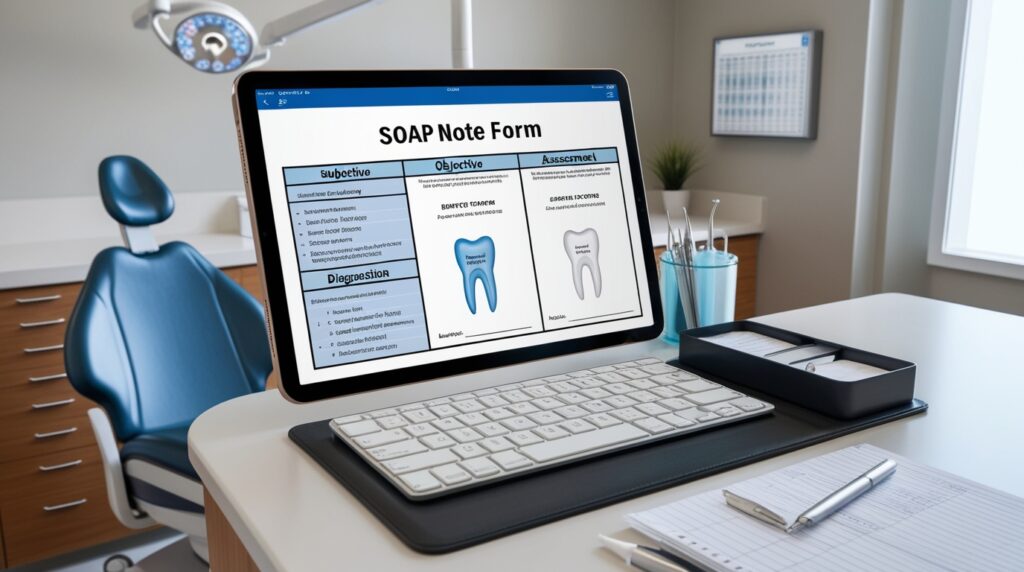
Dental SOAP Notes Template with Examples
Master the art of dental documentation with our comprehensive SOAP notes template. Learn how AI-powered tools can reduce your charting time by 70% while improving note quality and compliance.
What Are Dental SOAP Notes?
Dental SOAP notes are a structured documentation method that organizes patient information into four clear sections: Subjective, Objective, Assessment, and Plan. This systematic approach to clinical note-taking has become the gold standard in dental practices for recording patient encounters, treatment progress, and clinical decision-making.
Originally developed in the 1960s by Dr. Lawrence Weed for medical documentation, the SOAP note format has been widely adopted by dental professionals because it provides a logical, consistent framework that ensures comprehensive documentation while supporting clinical reasoning and continuity of care.
S – Subjective
Patient-reported symptoms, concerns, and history in their own words
O – Objective
Measurable clinical findings from examination and diagnostics
A – Assessment
Your professional diagnosis and clinical interpretation
P – Plan
Treatment recommendations and next steps
Pro Tip: When integrated with DentalAIAssist, your SOAP notes are automatically generated as you speak with patients. The AI listens to your conversation, extracts relevant information, and organizes it into properly formatted SOAP notes—saving you 20-30 minutes per session while ensuring nothing gets missed.
⚡ Stop Spending Hours on SOAP Notes
Discover how DentalAIAssist can automatically generate perfect SOAP notes while you focus on patient care.
Get Your Free Practice Assessment →
30-minute demo • See it in action • No commitment required
Why SOAP Notes Are Essential for Dental Practices
📋 Legal Protection & Risk Management
Well-documented SOAP notes provide crucial legal protection in case of malpractice claims or audits. They demonstrate that you conducted a thorough examination, considered all relevant factors, and made informed clinical decisions. The structured format ensures you document what matters most from a liability perspective.
💰 Insurance Reimbursement & Coding Support
Complete SOAP notes support accurate billing codes and medical necessity justification. Insurance companies often request documentation during claims review, and properly structured SOAP notes demonstrate the clinical rationale for your treatment decisions, reducing claim denials and improving reimbursement rates.
🔄 Continuity of Care
When multiple providers treat the same patient, SOAP notes ensure seamless handoffs. Associates, hygienists, and specialists can quickly understand the patient’s status, ongoing issues, and treatment trajectory. This is especially critical in group practices and multi-location dental organizations.
⚖️ Regulatory Compliance
State dental boards and regulatory agencies require thorough documentation of patient care. SOAP notes help you meet these requirements consistently while demonstrating adherence to standard of care principles.
📊 Quality Improvement & Patient Outcomes
Systematic documentation allows you to track treatment effectiveness over time, identify patterns, and make data-driven improvements to your clinical protocols. You can review what worked, what didn’t, and refine your approach for better patient outcomes.
⏱️ Practice Efficiency
Despite the perception that documentation takes time, well-structured SOAP notes actually improve efficiency. When you have a clear format to follow, charting becomes faster and more consistent—especially when augmented with AI tools like DentalAIAssist that automate the process.
Real-World Impact: Dr. James Chen, an orthodontist in Seattle, shared: “We used to spend 45-60 minutes each evening completing SOAP notes for the day’s patients. With DentalAIAssist, the notes are done automatically during the appointment, and I just review them. We’ve cut documentation time by 75% and the notes are actually more thorough than before.”
The Four Components of Dental SOAP Notes (Detailed Guide)
S – Subjective: Patient’s Perspective
The subjective section captures information from the patient’s point of view. This includes their chief complaint, symptoms, concerns, and relevant history. Use the patient’s own words when possible (in quotations) and document what they tell you, not what you observe.
What to Include in the Subjective Section:
- Chief Complaint (CC): The primary reason for the visit in the patient’s words
- History of Present Illness (HPI): Details about current symptoms (onset, duration, severity, triggers, relieving factors)
- Pain Assessment: Location, character, intensity (1-10 scale), frequency
- Functional Impact: How symptoms affect eating, speaking, sleeping, work
- Previous Treatments: What the patient has tried and the results
- Relevant Medical History: Recent health changes, new medications, hospitalizations
- Patient Concerns & Goals: What the patient hopes to achieve
Subjective Example:CC: “My upper left tooth has been hurting for about a week”
Patient reports sharp, throbbing pain in tooth #14 that started 7 days ago. Pain rated 7/10, worsens with hot and cold foods, and keeps him awake at night. Previously treated with OTC ibuprofen with minimal relief. Patient states he had a filling placed in this tooth approximately 5 years ago. No facial swelling noted by patient. Reports being unable to chew on left side due to discomfort.
Medical History Update: Started taking blood pressure medication (lisinopril 10mg) 2 months ago, otherwise no changes.
Patient’s Goal: “I just want the pain to stop so I can eat normally again.”
O – Objective: Clinical Findings
The objective section documents measurable, observable findings from your clinical examination and diagnostic tests. This is where you record what YOU see, feel, measure, and discover—not what the patient reports.
What to Include in the Objective Section:
- Vital Signs: Blood pressure, pulse (if taken)
- Extraoral Examination: Facial symmetry, lymph nodes, TMJ assessment, muscle palpation
- Intraoral Examination: Soft tissue findings, periodontal assessment, specific tooth findings
- Diagnostic Tests: Percussion, palpation, thermal tests, electric pulp testing
- Radiographic Findings: What you observe on X-rays, CBCT, etc.
- Measurements: Probing depths, mobility scores, recession measurements
- Previous Restorations: Condition of existing work
Objective Example:Extraoral: No facial swelling or asymmetry noted. Lymph nodes non-palpable. TMJ within normal limits.
Intraoral: Oral mucosa pink and healthy. Gingival tissue exhibits mild inflammation in upper left quadrant with bleeding on probing (BOP) at #14.
Tooth #14: Large MOD amalgam restoration present. Fracture line visible on mesial marginal ridge extending subgingivally. Percussion test: Positive, sharp pain. Palpation: Tenderness noted in apical region. Thermal test: Prolonged response to cold (30+ seconds). EPT: Exaggerated response at setting 4/10.
Radiographic Findings: Periapical radiograph shows large restoration approaching pulp chamber with periapical radiolucency approximately 3mm in diameter at apex of #14. Possible vertical root fracture suspected but not definitively visible on 2D imaging.
Periodontal: Probing depths 2-3mm throughout, BOP at #14 mesial and distal.
A – Assessment: Your Professional Diagnosis
The assessment section is where you synthesize the subjective and objective information to form your professional diagnosis and clinical opinion. This demonstrates your clinical reasoning and decision-making process.
What to Include in the Assessment Section:
- Primary Diagnosis: Most likely condition based on findings
- Differential Diagnoses: Other possibilities you’re considering
- Clinical Interpretation: What the findings mean
- Prognosis: Expected outcome (good, fair, poor, hopeless)
- Risk Factors: Factors that may affect treatment or outcome
- Complications: Any concerns or complicating factors
Assessment Example:Primary Diagnosis: Symptomatic irreversible pulpitis with symptomatic apical periodontitis, tooth #14
Contributing Factors:
– Large deep restoration approaching pulp
– Suspected vertical root fracture (clinical evidence strong, radiographic confirmation limited)
– Chronic pulpal inflammation progressing to necrosis
Differential Considerations:
– Cracked tooth syndrome (fracture extending into pulp)
– Acute apical abscess (though no purulence noted)
Prognosis: Questionable to poor due to suspected vertical root fracture. If fracture confirmed during treatment, tooth may not be restorable.
Risk Assessment: Patient is medically stable. New BP medication (lisinopril) should not affect treatment. No contraindications to endodontic therapy noted.
P – Plan: Treatment & Next Steps
The plan section outlines your treatment recommendations, patient education, prescriptions, referrals, and follow-up schedule. This should be specific, actionable, and clearly documented.
What to Include in the Plan Section:
- Treatment Recommendations: Specific procedures recommended
- Alternatives Discussed: Other options presented to patient
- Patient Education: Information provided about condition and treatment
- Consent: Note if consent forms were signed
- Prescriptions: Medications prescribed (drug, dose, frequency, quantity)
- Referrals: Specialists involved
- Follow-up: When to return and for what purpose
- Home Care Instructions: What patient should do at home
Plan Example:Treatment Recommended:
1. Endodontic evaluation and possible root canal therapy, tooth #14
2. If vertical root fracture confirmed during access, extraction of #14
3. If extraction required, discuss implant vs bridge options for replacement
Alternatives Discussed:
– Extraction with no replacement (patient declined due to esthetics and function)
– “Wait and see” approach (patient declined, wants pain relief)
– Immediate extraction without attempting RCT (patient prefers to try saving tooth first)
Patient Education:
– Explained diagnosis of irreversible pulpitis with apical periodontitis
– Discussed suspected fracture and implications for treatment success
– Reviewed RCT procedure, timeline, and success rates
– Explained possibility that tooth may not be savable if fracture extends into root
– Patient understands risks, benefits, and alternatives
Referral: Referred to Dr. Smith (Endodontist) for RCT consultation and treatment. Office contacted, appointment scheduled for [date].
Prescription:
– Ibuprofen 600mg PO q6h PRN pain (quantity: 20)
– Amoxicillin 500mg PO q8h x 7 days (if infection worsens before endo appointment)
Home Care Instructions:
– Avoid chewing on left side
– Use warm salt water rinses 3-4x daily
– Soft diet until treatment completed
– Call immediately if swelling develops
Follow-up:
– Endodontic appointment: [date] with Dr. Smith
– Return to our office post-RCT for crown preparation, or for extraction/implant planning if tooth non-restorable
– Emergency contact provided if pain worsens before endo appointment
Patient verbalized understanding and all questions answered. Consent form signed and in chart.
🎯 Automate Your SOAP Notes in Real-Time
Watch DentalAIAssist create perfect SOAP notes automatically while you examine your patient. No typing, no templates, no hassle.
See it work with your actual workflow • 30-minute session • Zero commitment
SOAP Notes Best Practices: Do’s and Don’ts
✓ DO
- Use the patient’s own words in quotes for subjective
- Be specific with measurements and findings
- Document all treatment options discussed
- Include patient education provided
- Note when patient consents or declines treatment
- Use standard abbreviations appropriately
- Document immediately after the appointment
- Include negative findings (what you ruled out)
- Date and sign all entries
- Proofread before finalizing
✗ DON’T
- Mix subjective and objective sections
- Use vague terms like “normal” without details
- Leave blank sections (write “none” if nothing to report)
- Use judgmental language about patients
- Make assumptions without clinical evidence
- Alter notes after the fact without notation
- Copy-paste from previous notes without reviewing
- Use unclear abbreviations
- Document personal opinions as facts
- Rush through notes at end of day
Common SOAP Note Mistakes to Avoid
❌ Mistake #1: Subjective/Objective Confusion
Wrong: “Patient has gingivitis” (in Subjective)
Right: “Patient reports bleeding gums” (Subjective) + “Gingival inflammation with BOP noted” (Objective)
❌ Mistake #2: Incomplete Assessment
Wrong: “Assessment: Cavity”
Right: “Assessment: Caries #19 (DO), moderate depth, approaching DEJ. Prognosis: Good with timely restoration.”
❌ Mistake #3: Vague Treatment Plans
Wrong: “Plan: Fix tooth”
Right: “Plan: Composite restoration #19 (DO), shade A2. Patient education provided on caries prevention. RTC 2 weeks.”
❌ Mistake #4: Missing Alternatives
Wrong: Not documenting other options discussed
Right: “Alternatives discussed: extraction vs RCT vs crown lengthening. Patient chose RCT with crown buildup.”
❌ Mistake #5: No Patient Education Documentation
Wrong: Assuming verbal education is sufficient
Right: “Home care instructions provided: soft diet 24hrs, avoid hot foods, ibuprofen PRN. Post-op instructions given in writing.”
📥 Download Free Dental SOAP Notes Templates
Get instant access to our professionally designed templates for different dental procedures
General Exam Template
Emergency Visit Template
Perio Charting Template
Restorative Template
SOAP Note Examples by Procedure Type
Example 1: Routine Hygiene Appointment
S: Patient presents for 6-month recall cleaning. Reports no dental pain or concerns. Brushes 2x daily, flosses 3-4x weekly. No changes to medical history. Occasional sensitivity to cold beverages in lower anteriors.O: BP 118/76. Extra/intraoral exam WNL. Soft tissue healthy. Generalized mild plaque accumulation. Slight calculus buildup lower anteriors lingual. Probing depths 2-3mm throughout with BOP at #24, #25. No caries detected on clinical or radiographic exam. Existing restorations intact.
A: Healthy periodontium with localized mild gingivitis, lower anteriors. Good oral hygiene compliance. Low caries risk. Sensitivity likely due to mild gingival recession (#24, #25 – 1mm).
P: Prophylaxis completed. Fluoride varnish applied. Discussed flossing technique and importance of daily use. Recommended desensitizing toothpaste for anterior sensitivity. Patient education on recession prevention. RTC 6 months for routine recall.
Example 2: Crown Preparation
S: Patient scheduled for crown preparation #30. Reports tooth fractured 3 weeks ago while eating. No pain currently. Previously declined RCT as tooth asymptomatic. Wants tooth restored to prevent further breakdown.O: Tooth #30: Large fracture of buccal cusp, extends to gingival margin. No caries evident. Vitality test: positive, normal response. Percussion/palpation: negative. Radiograph: no periapical pathology, adequate bone support. Adequate structure for crown retention.
A: Fractured tooth #30, vital pulp, adequate tooth structure for crown. Prognosis: Good for crown restoration. No immediate endo indicated but patient aware of possible future need if symptoms develop.
P: Full coverage crown preparation #30 completed. Provisonal crown placed with Temp-Bond. Impression taken (PVS), bite registration recorded. Shade: A3. Lab work order submitted to [Lab Name]. Post-op instructions provided: avoid sticky foods, soft diet, call if provisional comes off. Prescribed: Ibuprofen 400mg PRN. RTC 2 weeks for crown delivery. Patient consented, understands possible future RCT need if tooth becomes symptomatic.
Example 3: Emergency Toothache
S: Patient presents as emergency with severe tooth pain #3. Pain started 2 days ago, progressively worsening. Rated 9/10. Constant throbbing, worse with hot foods, unable to sleep last night. Has taken ibuprofen with minimal relief. No facial swelling noted by patient. Previously had filling in this tooth “years ago.”O: Alert, appears uncomfortable. BP 142/88 (elevated, likely due to pain). Slight facial asymmetry, mild swelling right maxilla. Intraoral: fluctuant swelling buccal to #3. Tooth #3: large amalgam restoration, fractured. Extremely sensitive to percussion. Palpation: severe tenderness, fluctuance in vestibule. Thermal: no response (necrotic). Radiograph: large restoration, periapical radiolucency 5mm diameter, widened PDL.
A: Necrotic pulp with acute apical abscess, tooth #3. Significant periapical pathology evident. Prognosis: Guarded but tooth may be savable with endodontic therapy.
P:
1. Incision and drainage performed, purulent exudate expressed, irrigated with saline
2. Referred to Dr. Lee (Endodontist) for emergency RCT – appointment scheduled today 3pm
3. Prescribed: Amoxicillin 500mg TID x 7 days, Ibuprofen 600mg q6h PRN
4. Patient education: warm salt rinses, soft diet, importance of completing antibiotic course
5. Follow up with endodontist as scheduled
6. Call our office if swelling worsens or fever develops
7. Return to our office post-RCT for crown restoration
Patient verbalized understanding, consented to I&D, referral arranged. Emergency contact provided.
SOAP Notes vs Other Documentation Formats
| Format | Structure | Best For | Advantages |
|---|---|---|---|
| SOAP Notes | Subjective, Objective, Assessment, Plan | Most clinical encounters, progress notes | Systematic, comprehensive, widely recognized, supports clinical reasoning |
| DARE Notes | Data, Assessment, Response, Education | Hygiene appointments, preventive visits | Simple, quick for routine visits, emphasizes patient education |
| Narrative Notes | Free-form chronological description | Simple procedures, very brief encounters | Flexible, quick for experienced providers |
| Problem-Oriented | Problem list with SOAP for each issue | Complex cases with multiple conditions | Organized by problem, good for chronic management |
Why SOAP Notes Win: While other formats have their place, SOAP notes remain the gold standard because they’re structured enough to ensure completeness yet flexible enough for any type of encounter. They’re universally understood, satisfy legal and regulatory requirements, and support both clinical decision-making and practice management needs.
How DentalAIAssist Revolutionizes SOAP Note Documentation
Traditional SOAP note documentation is time-consuming and often gets pushed to the end of the day when you’re exhausted. DentalAIAssist changes this completely with AI-powered automatic documentation:
🎤 Real-Time Transcription
As you conduct your examination and speak with your patient, DentalAIAssist listens and captures every detail. You don’t need to think about documentation during the appointment—just have a natural conversation with your patient and perform your examination as you normally would.
🧠 Intelligent SOAP Organization
The AI automatically sorts information into the correct SOAP sections:
- Patient complaints and symptoms → Subjective
- Your clinical findings → Objective
- Your diagnosis and reasoning → Assessment
- Your treatment recommendations → Plan
✨ Specialty-Specific Templates
Customize SOAP note templates for different appointment types:
- New patient comprehensive exams
- Emergency visits
- Hygiene recalls
- Restorative procedures
- Surgical procedures
- Orthodontic progress checks
- Periodontal maintenance
🔄 EHR Integration
SOAP notes flow directly into your practice management system (Dentrix, Eaglesoft, Open Dental, etc.) with no manual data entry required.
📊 Quality Assurance
The AI checks for completeness and flags missing elements before you finalize notes, ensuring every SOAP note meets documentation standards.
Time Savings: Dr. Amanda Rodriguez, a general dentist in Austin, reported: “Before DentalAIAssist, I spent 2-3 hours every evening finishing my SOAP notes. Now they’re done automatically during the appointment, and I just do a quick review. I’ve gone from 15 hours a week on documentation to maybe 2 hours. It’s given me my life back.”
🚀 Transform Your Documentation Workflow
See how DentalAIAssist can help you:
- ✓ Eliminate manual SOAP note writing
- ✓ Reduce documentation time by 70%+
- ✓ Improve note quality and completeness
- ✓ Never miss critical documentation
- ✓ Focus fully on patient care
Book Your Free Practice Assessment →
30-minute personalized demo • See your workflow automated • Zero obligation
Frequently Asked Questions About Dental SOAP Notes
How long should dental SOAP notes be?
SOAP notes should be as long as necessary to completely document the encounter—typically 150-400 words for routine visits, 300-600 words for complex cases. Focus on completeness over brevity, but avoid unnecessary repetition. With DentalAIAssist, comprehensive notes are generated automatically regardless of length, so you never have to worry about being too brief or too verbose.
Are SOAP notes required by law for dental practices?
While specific requirements vary by state, all states require dentists to maintain adequate patient records. SOAP notes are not legally mandated everywhere, but they represent the standard of care for clinical documentation and are highly recommended by dental boards, insurance companies, and legal experts. They provide the most comprehensive legal protection in case of disputes or malpractice claims.
Can I use abbreviations in SOAP notes?
Yes, but use standard dental abbreviations that are widely recognized (e.g., BOP for bleeding on probing, RCT for root canal therapy). Avoid creating your own abbreviations or using unclear shorthand. When in doubt, spell it out. Many practices maintain an approved abbreviation list to ensure consistency across providers.
How long should I keep dental SOAP notes?
Record retention requirements vary by state, but most states require 7-10 years for adult patients and until the patient reaches age 21-25 for minors (whichever is longer). Check your state dental board regulations. Many practices keep records indefinitely in digital format since storage costs are minimal.
What if I need to correct a SOAP note after it’s finalized?
Never alter original notes. Instead, add an addendum clearly labeled with the current date, noting “Addendum to [original date] note:” followed by your correction or addition. Sign and date the addendum. This shows you’re making a legitimate correction rather than altering records after the fact, which is crucial for legal protection.
Should SOAP notes include information about no-shows or cancellations?
Yes! Document all scheduled appointments including no-shows, late cancellations, and reschedules. Note any attempts to reach the patient and their response. This creates a complete timeline of care and demonstrates due diligence if treatment delays lead to worsening conditions.
How does DentalAIAssist ensure HIPAA compliance with SOAP notes?
DentalAIAssist is built with HIPAA compliance as a core feature. All patient data is encrypted in transit and at rest, access is controlled and audited, and the system never shares data with unauthorized third parties. The AI processes information securely and integrates directly with your HIPAA-compliant EHR system. During your free assessment, we provide a complete overview of our security protocols.
Ready to Automate Your SOAP Notes?
Join hundreds of dentists who’ve eliminated documentation stress with DentalAIAssist.