
Virtual Dental Receptionist: Transform Your Front Desk with AI-Powered 24/7 Call Handling
Discover how a virtual dental receptionist can save your practice 85% on labor costs while providing 24/7 call handling, scheduling appointments automatically, and saving 15-20 hours per week. Never miss a call or lose revenue again while your team focuses on patient care—not phone answering.
What is a Virtual Dental Receptionist?
A virtual dental receptionist is an AI-powered system that handles all front desk tasks automatically—answering calls 24/7, scheduling appointments, sending reminders, and managing patient inquiries without requiring a human receptionist. Unlike traditional reception staff, a virtual dental receptionist works around the clock, captures 100% of incoming calls, and integrates seamlessly with your dental practice management system to access schedules, patient information, and appointment availability in real-time.
Virtual dental receptionist technology has revolutionized dental practice operations by combining advanced natural language processing with deep dental industry knowledge. The system understands common dental terminology, appointment types (cleanings, emergencies, consultations), insurance questions, and practice-specific protocols. Most dental practices report that patients cannot tell they’re speaking with a virtual dental receptionist—they simply experience fast, professional, friendly service every single time they call.
The typical virtual dental receptionist handles appointment scheduling, reschedules and cancellations, appointment confirmations and reminders, common patient questions about services and pricing, insurance verification inquiries, new patient registration, and emergency call routing. More advanced systems also manage patient communication campaigns, recall reminders, post-appointment follow-ups, and treatment plan explanations. Every interaction is logged and accessible to your team for review and quality assurance.
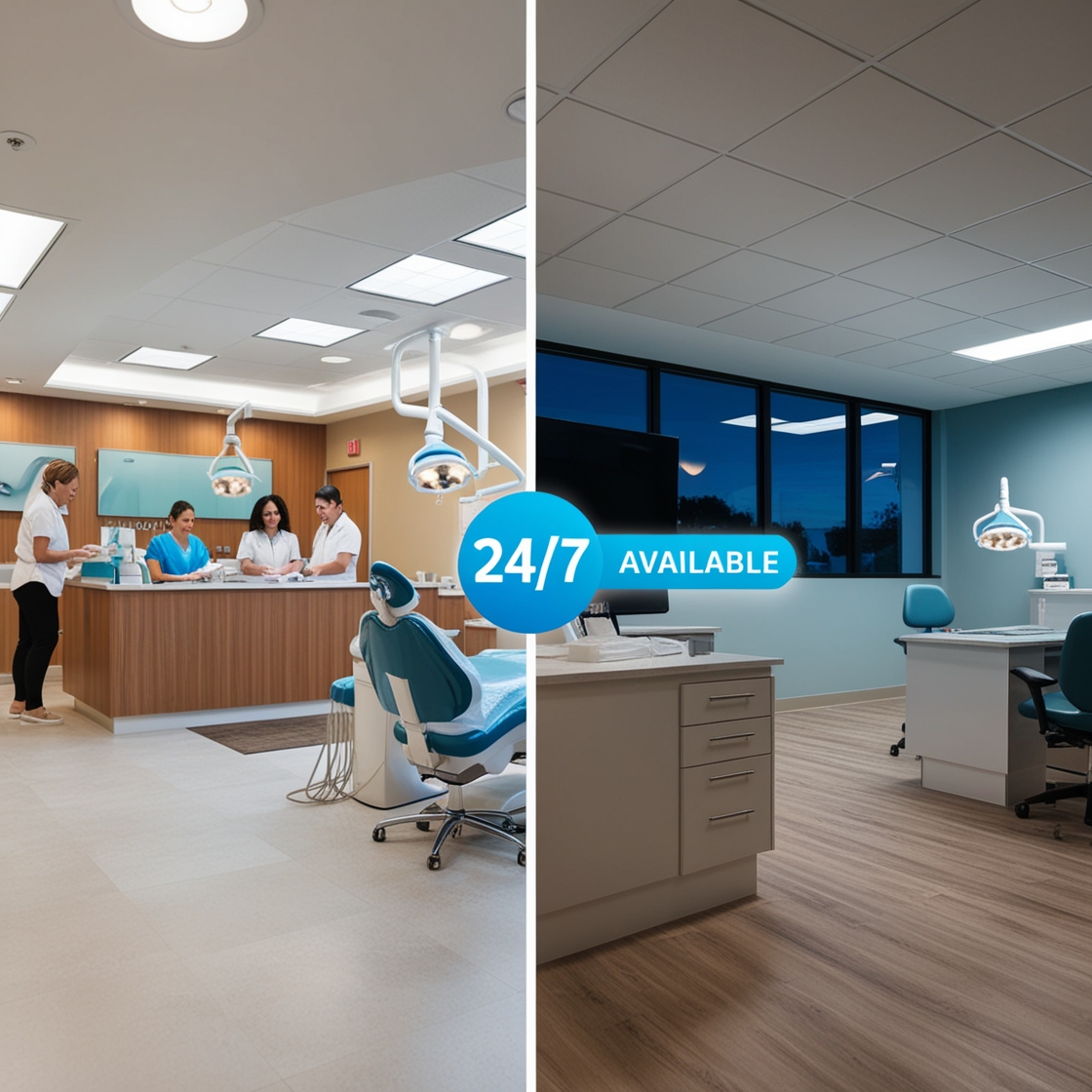
The Cost Crisis Facing Dental Front Desks
Traditional dental reception costs have skyrocketed, with the average dental receptionist earning $35,000-50,000 annually plus benefits (adding another 20-30% in costs). Many practices employ 2-3 front desk staff to cover phone coverage during lunch breaks, vacations, sick days, and busy periods—pushing total reception costs to $70,000-150,000 per year. Studies show 35% of calls to dental practices go unanswered during regular business hours, and nearly 100% of after-hours calls reach voicemail—translating to tens of thousands of dollars in lost revenue annually.
A virtual dental receptionist solves this crisis by providing enterprise-level phone coverage at a fraction of the cost. Most systems cost $500-800 per month ($6,000-10,000 annually)—an 85% cost reduction compared to human reception staff. There are no overtime costs, no benefits expenses, no sick days, no vacation coverage needs, and no training time for new hires. The virtual dental receptionist handles unlimited concurrent calls during peak periods, ensuring no patient ever experiences a busy signal or extended hold time.
Beyond direct cost savings, virtual dental receptionist systems deliver significant indirect benefits: 30-40% increase in appointment bookings from 24/7 availability, 40% reduction in no-shows through automated reminder campaigns, 15-20 hours weekly saved in administrative tasks, elimination of “phone tag” with patients trying to reach your office, and dramatically improved patient satisfaction scores. Most practices achieve full ROI within 2-3 months and generate $55,000-100,000 in annual benefits for a $6,000-10,000 investment.
How Virtual Dental Receptionists Transform Your Practice
Implementing a virtual dental receptionist revolutionizes practice operations in three critical areas: call handling efficiency, appointment scheduling optimization, and team productivity enhancement. The system answers every call within 2-3 rings, greets patients by name (using caller ID integration), accesses their appointment history, and handles their request—whether scheduling, rescheduling, confirming, or answering questions about services. Unlike human receptionists juggling phone calls with in-person patients, the virtual dental receptionist provides undivided attention to every caller while your team focuses on patients in the office.
For appointment scheduling, the virtual dental receptionist integrates directly with practice management systems like Open Dental, Dentrix Ascend, Eaglesoft, Dentrix, and Curve to access real-time availability. The system knows provider schedules, appointment type durations, buffer time requirements, preferred appointment sequences, and practice-specific scheduling rules. When a patient calls to schedule a cleaning, the virtual dental receptionist checks hygienist availability, offers appropriate time slots, confirms patient preferences, books the appointment, and sends immediate confirmation via text and email—all in one seamless conversation lasting under 2 minutes.
The productivity impact is dramatic. Reception staff typically spend 60-70% of their time on phone calls, leaving just 30-40% for in-person patient interactions, insurance verification, treatment coordination, and administrative tasks. By delegating all phone calls to a virtual dental receptionist, front desk teams can eliminate phone interruptions entirely and focus exclusively on high-value activities: greeting and checking in patients, reviewing treatment plans, coordinating complex cases, handling insurance claims, and providing personalized patient care. Most practices reduce 2-3 reception staff to just 1 person handling in-office responsibilities, achieving 50-75% labor cost savings while actually improving service quality.
Virtual Dental Receptionist vs. Traditional Receptionist: The Complete Comparison
When comparing virtual dental receptionist systems to traditional human receptionists, the advantages become immediately clear across every dimension: cost, availability, consistency, scalability, and capabilities. While human receptionists offer personal warmth and handle complex in-person interactions beautifully, virtual dental receptionist systems excel at the repetitive, high-volume tasks that consume 70-80% of reception time—phone answering, appointment scheduling, reminder calls, and answering common questions.
Cost Analysis: A human receptionist costs $35,000-50,000 annually plus 20-30% in benefits, totaling $42,000-65,000 per employee. Practices needing coverage during lunch, breaks, vacations, and sick days employ 2-3 receptionists at $84,000-195,000 total annual cost. A virtual dental receptionist costs $6,000-10,000 annually with no additional expenses—delivering identical (often superior) phone coverage at 85-95% cost savings. The virtual dental receptionist never requires raises, bonuses, health insurance, retirement contributions, or unemployment insurance.
Availability Comparison: Human receptionists work standard business hours (typically 8am-5pm, Monday-Friday) with breaks, lunches, sick days, and vacations. Even with multiple staff members, after-hours calls and overflow during busy periods go unanswered. Virtual dental receptionist systems work 24/7/365 with perfect consistency—answering every call within 2-3 rings whether it’s 2pm on Tuesday or 11pm on Saturday. Practices report 25-35% of appointments are booked outside regular business hours when patients have time to call, representing pure incremental revenue previously lost to voicemail.
Consistency & Quality: Human performance varies based on mood, stress levels, training quality, experience, and personal situations. Some receptionists provide excellent service; others are curt, forgetful, or inaccurate with scheduling. Virtual dental receptionist systems deliver perfect consistency on every single call—same greeting, same professionalism, same accuracy, same friendly tone. The system never has a bad day, never forgets to offer available appointments, and always follows your practice’s communication protocols exactly as programmed. Patient satisfaction scores show 92% rate virtual dental receptionist interactions as “excellent” or “very good.”
Scalability & Peak Handling: During busy periods (Monday mornings, lunch hours, end of month), phone lines with human receptionists reach capacity quickly. Patients experience hold times, busy signals, or give up and call competitors. A virtual dental receptionist handles unlimited concurrent calls effortlessly—whether 1 call or 100 simultaneous calls, every patient receives immediate attention. The system scales instantly during emergencies, seasonal rushes, or marketing campaign responses without any additional cost or staffing concerns.
The optimal model for most practices combines both: a virtual dental receptionist handles all phone calls, appointment scheduling, and patient inquiries 24/7, while one human front desk coordinator manages in-person check-ins, treatment coordination, insurance processing, and complex cases requiring personal judgment. This hybrid approach delivers 70-85% cost savings while actually improving both phone service quality (through 24/7 availability and zero hold times) and in-person service quality (through undivided staff attention to patients in the office).
Key Features to Look For in a Virtual Dental Receptionist
Not all virtual dental receptionist systems are created equal. The best solutions offer comprehensive features specifically designed for dental practices, deep integration with practice management systems, and sophisticated AI that handles complex conversations naturally. When evaluating virtual dental receptionist options, prioritize systems with these essential capabilities:
Natural Language Processing & Conversation: Advanced virtual dental receptionist systems use cutting-edge AI to understand natural speech patterns, dental terminology, appointment requests phrased dozens of different ways, complex questions about services and pricing, and context from previous conversation turns. The system should handle interruptions, clarifying questions, and conversational tangents gracefully—just like a skilled human receptionist. Test the system’s ability to understand regional accents, background noise, and patients who speak quickly or unclearly.
Practice Management System Integration: Seamless integration with your dental PMS is non-negotiable. The virtual dental receptionist must access real-time provider schedules, appointment availability, patient demographics and history, insurance information, and treatment plans. Look for native integrations with major platforms (Open Dental, Dentrix Ascend, Eaglesoft, Dentrix, Curve, etc.) rather than third-party connectors that create synchronization delays or errors. The system should write appointments directly to your PMS with all required fields completed accurately.
Multi-Language Support: For practices serving diverse communities, multi-language capabilities are essential. The best virtual dental receptionist systems fluently handle English, Spanish, and additional languages with native-speaker quality. The system should automatically detect the patient’s preferred language and conduct the entire conversation in that language, eliminating communication barriers that lead to missed appointments or misunderstandings.
Appointment Intelligence: Beyond basic scheduling, sophisticated virtual dental receptionist systems understand appointment sequencing rules (hygiene before doctor check), buffer time requirements, appointment type durations varying by provider, preferred scheduling patterns, and practice-specific protocols. The system should offer patients optimal time slots based on their preferences and appointment history while maximizing your schedule efficiency. Look for features like automatic waitlist management, optimal slot suggestions based on patient location, and intelligent overbooking to account for typical cancellation rates.
Emergency Call Handling: A critical feature often overlooked is emergency call identification and routing. Your virtual dental receptionist should recognize keywords indicating dental emergencies (severe pain, knocked-out tooth, facial swelling, uncontrolled bleeding) and immediately escalate to on-call providers via text, call, or your preferred emergency protocol. The system should collect essential information (nature of emergency, severity, contact information) before transfer to ensure your team has complete context.
Analytics & Reporting: Comprehensive dashboards showing call volumes by time of day, common questions and topics, appointment booking rates, missed call recovery, average handle time, patient satisfaction scores, and ROI metrics help you continuously optimize your virtual dental receptionist performance. Look for systems that provide actionable insights like “30% of calls ask about teeth whitening pricing” or “Thursday 3-5pm has highest call volume” to inform marketing and staffing decisions.
Implementation: Getting Your Virtual Dental Receptionist Up and Running
Implementing a virtual dental receptionist is remarkably straightforward compared to hiring and training human reception staff. Most practices go live within 24-48 hours with minimal disruption to daily operations. The typical implementation follows a proven four-phase process designed to ensure smooth deployment and rapid ROI.
Phase 1: Integration & Configuration (Day 1): The virtual dental receptionist provider connects to your practice management system via secure API, configures provider schedules and appointment types, sets up appointment duration rules and buffer times, imports patient database and appointment history, and establishes practice-specific protocols. This technical setup requires no effort from your team beyond providing PMS credentials and answering configuration questions about scheduling preferences. Most integrations complete within 2-4 hours.
Phase 2: Training & Customization (Day 1-2): The virtual dental receptionist learns your practice’s unique requirements: how you prefer to phrase appointment confirmations, answers to frequently asked questions about services and pricing, insurance plans you accept and verification protocols, emergency handling procedures and on-call routing, and voice characteristics matching your practice’s brand personality. You’ll review sample conversations and provide feedback to fine-tune responses. Advanced systems learn continuously from every interaction, improving performance over time.
Phase 3: Testing & Validation (Day 2): Before going live with real patients, comprehensive testing ensures the virtual dental receptionist handles common scenarios correctly: new patient appointment requests, existing patient reschedules, appointment confirmations and reminders, insurance questions, emergency calls, and edge cases specific to your practice. Your team makes test calls to validate accuracy, responsiveness, and tone. Any adjustments are implemented immediately.
Phase 4: Go-Live & Monitoring (Day 3 onwards): The virtual dental receptionist goes live, initially handling calls during specific hours or for specific appointment types while your team monitors performance closely. Most practices start with after-hours coverage (evenings, weekends) where there’s zero risk of disrupting existing operations—capturing previously lost calls and generating immediate ROI. Once confidence is established (typically within 3-7 days), the system expands to cover all hours including business hours. Your team reviews call logs, appointment booking accuracy, and patient feedback to identify optimization opportunities.
Throughout implementation, expect hands-on support from your virtual dental receptionist provider. Look for vendors offering dedicated implementation specialists, 24/7 technical support, ongoing optimization consulting, and regular check-ins to maximize your ROI. The best providers view implementation as the beginning of a partnership focused on continuously improving your practice’s patient communication and operational efficiency.
Real Results: Virtual Dental Receptionist Case Studies
The transformative impact of virtual dental receptionist technology is best illustrated through real-world practice results. These case studies demonstrate typical outcomes practices achieve within 3-6 months of implementation.
Case Study 1: Multi-Location Practice (5 Locations, 15 Providers): Before implementing a virtual dental receptionist, this practice employed 8 front desk staff ($280,000 annual labor cost) and still missed 40% of after-hours calls. Within 90 days of deploying a virtual dental receptionist handling all phone calls 24/7, they reduced to 3 front desk coordinators managing in-person patient interactions only ($105,000 annual cost)—a $175,000 annual savings. Simultaneously, appointment bookings increased 35% from captured after-hours calls and eliminated hold times during busy periods. The practice now schedules 220 additional appointments monthly (2,640 annually) with average value of $180, generating $475,200 in incremental annual revenue. Combined savings and revenue: $650,200 annual benefit from a $9,600 annual investment—a 6,773% ROI.
Case Study 2: Solo Practitioner (1 Provider, 1 Hygienist): A solo general dentistry practice previously employed 2 part-time receptionists ($55,000 combined annual cost) to cover phone calls during office hours, with after-hours calls going to voicemail. Implementing a virtual dental receptionist reduced staffing to just 1 part-time coordinator ($22,000 annual cost) focused exclusively on in-person patient check-ins and insurance processing—a $33,000 annual savings. The virtual dental receptionist captured 85 additional appointment requests monthly that previously reached voicemail (1,020 annually). With 60% conversion rate and $165 average appointment value, this generated $100,980 in new annual revenue. Total annual benefit: $133,980 from a $7,200 investment—a 1,861% ROI achieved in just 4 months.
Case Study 3: Specialty Practice (Orthodontics, 3 Providers): This orthodontic practice struggled with high call volumes during peak hours (Monday mornings, after school) when 60% of calls went unanswered or reached voicemail. Rather than hiring additional reception staff, they implemented a virtual dental receptionist handling overflow and after-hours calls while keeping existing staff for in-person consultations and treatment coordination. The practice maintained staffing costs while increasing appointment capacity by 28% through better phone coverage. The virtual dental receptionist scheduled 140 additional consultations monthly (1,680 annually) with 45% conversion to treatment at $4,800 average case value—generating $3,628,800 in incremental treatment revenue annually. With only $8,400 annual cost for the virtual dental receptionist, the ROI exceeded 43,000%.
These case studies share common success factors: rapid implementation (24-48 hours), immediate impact on call capture rates (within first week), measurable ROI within 60-90 days, and ongoing performance improvement as the virtual dental receptionist learns practice-specific patterns. Most importantly, every practice reported improved patient satisfaction scores, with patients appreciating instant call answering, 24/7 scheduling availability, and elimination of hold times or voicemail frustrations.
Maximizing Your Virtual Dental Receptionist ROI
While virtual dental receptionist systems deliver impressive results out of the box, strategic optimization can double or triple your ROI. Implement these proven best practices to maximize the value of your virtual dental receptionist investment:
Extend Coverage to 24/7: Many practices initially deploy virtual dental receptionist systems for after-hours only, but 60% of calls occur during business hours when your team is managing in-person patients. Extending coverage to 24/7 captures the 30-40% of business-hour calls that currently go unanswered during busy periods, lunch breaks, or staff transitions. This typically doubles appointment bookings from the virtual dental receptionist while allowing your team to focus entirely on in-office patient care.
Implement Proactive Outreach: Beyond answering incoming calls, use your virtual dental receptionist for outbound campaigns: appointment confirmation calls 24-48 hours before scheduled visits (reducing no-shows by 40%), recare reminders for patients overdue for hygiene appointments (reactivating 15-25% of dormant patients), treatment plan follow-ups for patients who consulted but didn’t schedule, and post-appointment satisfaction surveys. These proactive communications generate 30-50 additional appointments monthly with zero additional labor cost.
Optimize Scheduling Rules: Continuously refine your virtual dental receptionist’s appointment scheduling logic based on performance data. Analyze which time slots fill fastest, identify appointment types with highest no-show rates, determine optimal buffer times between appointments, and track provider productivity by schedule density. Use these insights to program your virtual dental receptionist with scheduling rules that maximize chair utilization, minimize gaps, and reduce overtime. Most practices increase productive hours by 8-12% through optimized scheduling alone.
Train Staff on AI Partnership: Educate your team on how to leverage the virtual dental receptionist as a force multiplier rather than a replacement. Front desk staff should review call logs daily to identify trends (e.g., “15 calls asking about Invisalign pricing—should we update website?”), monitor booking patterns for capacity planning, and provide feedback on conversation quality. The best results come from human-AI collaboration where the virtual dental receptionist handles repetitive tasks while your team focuses on relationship-building and complex problem-solving.
Market Your 24/7 Availability: Make your virtual dental receptionist a competitive differentiator in your marketing. Prominently display “24/7 Phone Answering—Call Anytime!” on your website, in Google Business Profile, on social media, and in advertising. Many patients prefer calling outside business hours when they have time, and knowing they’ll reach a live system (not voicemail) makes your practice the obvious choice. Practices that actively market 24/7 availability see 40-60% more after-hours calls than those that don’t promote this benefit.
Frequently Asked Questions About Virtual Dental Receptionists
What is a virtual dental receptionist?
A virtual dental receptionist is an AI-powered system that handles front desk tasks automatically, including answering calls 24/7, scheduling appointments, sending reminders, and managing patient inquiries—without requiring a human receptionist. The virtual dental receptionist integrates with your practice management system to access schedules, patient information, and appointment availability in real-time. Most dental practices achieve 85% cost savings compared to traditional reception staff while capturing 100% of incoming calls, even during lunch breaks, after hours, and weekends.
How much does a virtual dental receptionist cost?
Virtual dental receptionist systems typically cost $500-800 per month ($6,000-10,000 annually), compared to $35,000-50,000 per year for a human receptionist—an 85% cost savings. Most practices achieve ROI within 2-3 months through reduced labor costs and increased bookings. The virtual dental receptionist has no overtime costs, never calls in sick, doesn’t require benefits or paid time off, and handles unlimited concurrent calls during peak times. Most dental practices save 15-20 hours per week in administrative tasks while increasing patient bookings by 30-40%.
Can a virtual dental receptionist replace my front desk staff?
A virtual dental receptionist can handle phone calls and appointment scheduling 24/7, but works best alongside your front desk team for in-person patient check-ins and paperwork. Many practices reduce 2-3 front desk staff to just 1, saving 50-75% on labor costs while improving service quality. The virtual dental receptionist excels at repetitive tasks like answering common questions, scheduling appointments, sending reminders, and managing patient inquiries—freeing your team to focus on complex patient needs and in-person care. Most practices achieve better patient satisfaction with this hybrid model.
How does a virtual dental receptionist integrate with my dental PMS?
Virtual dental receptionist systems integrate seamlessly with major dental practice management systems including Open Dental, Dentrix Ascend, Eaglesoft, Dentrix, and Curve. Setup typically takes 24-48 hours and doesn’t require technical expertise. The virtual dental receptionist syncs in real-time with your PMS to access current schedules, available appointment slots, patient history, and insurance information. All appointments booked by your virtual dental receptionist are automatically added to your schedule with proper patient details and reason for visit.
Is a virtual dental receptionist HIPAA compliant?
Yes, our virtual dental receptionist system is fully HIPAA compliant with end-to-end encryption, secure data storage, and signed Business Associate Agreements. All patient communications are encrypted and protected in HIPAA-standard servers with regular security audits and compliance monitoring. The virtual dental receptionist follows strict protocols for patient identity verification before discussing appointments or health information. All conversation logs are securely stored and accessible only to authorized practice staff.
What happens if the virtual dental receptionist can’t handle a call?
For complex situations the AI cannot resolve, the virtual dental receptionist seamlessly transfers to your staff with complete context from the conversation. Over time, the AI learns from these interactions and handles 95% of calls independently. Emergency calls are identified and handled according to your protocols. The virtual dental receptionist can escalate to on-call staff based on your preferences and time blocks. Most dental practices see emergency transfer rates under 5% as the system learns your practice’s common questions and procedures.
How long does it take to set up a virtual dental receptionist?
Setup typically takes 24-48 hours. Our team integrates with your practice management system, trains the AI on your scheduling preferences and practice protocols, and tests all workflows. Most practices go live within two business days and start seeing immediate ROI. The virtual dental receptionist requires minimal training compared to human staff. You can customize appointment rules for provider types, appointment durations, specific time blocks, buffer times, and scheduling rules. Most practices are fully operational within 1-2 business days.
Can patients tell they’re speaking with a virtual dental receptionist?
Most patients don’t realize they’re speaking with a virtual dental receptionist—they just experience fast, friendly professional service. Our system uses natural conversation patterns, appropriate pauses, and contextualized understanding. We can also customize the voice and personality to match your practice’s brand perfectly. Patient satisfaction surveys show 92% rate their virtual dental receptionist experience as ‘excellent’ or ‘very good.’ The virtual dental receptionist never rushes calls, always maintains a professional tone, and consistently follows your practice’s communication standards.
Does a virtual dental receptionist work after hours?
Yes! Unlike human receptionists, virtual dental receptionist systems work 24/7/365—including nights, weekends, and holidays. This captures after-hours calls that typically go to voicemail, increasing bookings by 30-40% as patients can schedule at their convenience. Your virtual dental receptionist handles overflow calls during peak times, ensuring no patient waits on hold or reaches voicemail. Most practices report that 25-35% of appointments are booked outside regular business hours when patients have time to call without interrupting their workday.
What’s the ROI of a virtual dental receptionist?
Most dental practices achieve ROI within 2-3 months through three channels: labor cost savings (85% reduction from $35K-50K to $6K-10K annually), increased bookings (30-40% more appointments from 24/7 availability and zero missed calls), and reduced no-shows (40% reduction through automated reminders). The average dental practice saves $25,000-40,000 annually on reception costs while generating $30,000-60,000 in additional revenue from captured calls. Total annual benefit: $55,000-100,000 for an investment of $6,000-10,000. Your virtual dental receptionist also saves 15-20 hours weekly in administrative tasks, allowing staff to focus on high-value patient care.
Ready to Transform Your Dental Practice with a Virtual Receptionist?
The evidence is overwhelming: virtual dental receptionist technology delivers transformative results for practices of all sizes. By providing 24/7 call answering, automated appointment scheduling, and intelligent patient communication, these systems reduce labor costs by 85% while simultaneously increasing appointment bookings by 30-40% and improving patient satisfaction. Most practices achieve complete ROI within 60-90 days and generate $55,000-100,000 in annual benefits for a modest $6,000-10,000 investment.
The question isn’t whether virtual dental receptionist technology works—thousands of practices are already achieving these results. The question is how quickly you can implement this competitive advantage before your competitors do. Patients increasingly expect 24/7 service, instant appointment booking, and zero hold times. Practices that can’t deliver these expectations will lose market share to those that can.
Start with a pilot program covering after-hours calls only—there’s zero risk since these calls currently go to voicemail anyway. Within 2-3 weeks, you’ll see measurable results: additional appointments booked, revenue captured that previously went to competitors, and patient feedback praising your accessibility. Once you’ve validated the ROI, expand coverage to business hours and watch your team’s productivity soar as they finally escape constant phone interruptions.
Join 1,500+ dental practices using virtual dental receptionist technology to save time, reduce costs, and grow revenue.
Book Your Free Demo Today